Black Americans, the ethnic group also known as Foundational Black Americans, African Americans, Ethnic Black Americans and many other endonyms, have been noted as being primarily responsible for the reclaiming and redefining of the term Black into a positive. What was once used for centuries by Europeans as the default of many things negative and abhorrent, Black Americans completely shaped the term into a positive, confident, cultural powerful and political force as well as ethnic endonym for their own group of people, so much so that even those who used to shun the term have become proud to be racially black, despite not being ethnically so.
This reclamation of the term black has shifted the entire globe, but let’s go back further to discover a well-known man who was very influential for the foundation of what became known as Black Excellence, Black Pride, Black Resilience and Black Power in Black America..
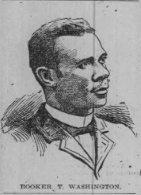
Booker T. Washington, known for his roots in slavery and how he came up to be one of the most powerful influences of the 1800s and early 1900s, and even beyond his death, being an author and the founder of the prestigious Tuskegee University in the state of Alabama, it was in the 1800s that Booker T. Washington made a speech that placed power and dignity behind the word black when it came to his people, and this in itself isn’t surprising because as the man who grew Tuskegee Institute into the established educational place of rigorous academia and Black Excellence, the same place where the best trained military pilots that the world had ever seen – The Tuskegee Airman – is the same man who drew the attention of white and black men around the globe to hear him speak.
Yes, it was this famous orator Booker T. Washington that made a speech in 1896 that was documented and printed both in the USA and in Europe – around the globe where there was print – that expressed the resilience, excellence and power of his Black people in America.
“We Are Black”
His speech in 1896 (documented in the Times Union; The Standard Union newspaper of Brooklyn, NY on January 13th) and possibly other speeches in previous years, addressed the gentlemen at the Hamilton Club which was a prominent social club consisting of what would be considered as elite men. Washington spoke on Black people, and mentioned the term Black about 18 times as referring to his people in America. In the introduction of his speech, it reads:
“I was born a slave on a plantation in Virginia, in 1857 or 1858, I think. My first memory of life is that of a one-room log cabin with a dirt floor and a hole in the center that served as a winter home from sweet potatoes, and wrapped in a few rags on this dirt floor I spent my nights, and clad in a single garment about the plantation, I often spent my days.”
“The morning of freedom came, and though a child, I recall vividly my appearance with that of forty or fifty slaves before the veranda of the “Big House” to hear read the documents that made us men instead of property. With the long prayed for freedom in actual possession, each started out in tot he world to find new friends and new homes. My mother decided to locate in West Virginia…”
Then, he revealed working in coal mines as a boy to support his mother before learning of General Armstrong’s school in Hampton, Virginia where “a poor boy could work for his education.” That’s when he began to save money to travel there and attend, arriving to the city of Richmond out of money and having to sleep under a sidewalk, before the next day finding work on a ship to earn money again during the day while sleeping under the sidewalk nightly until he saved enough money to make it to the school, speak with General Armstrong and successfully gain entrance into the school with only 50 cents left in his pocket, with a firm promise to himself that he would return to the South and create an opportunity for his people, for the youth of his race that he found “ready for him” when he got there.
Booker T. Washington decided on a pattern of study that didn’t follow any other group’s but chose to only focus on what his people needed and the courses of study necessary for a group of people finally building their own. He didn’t want to replicate a white institution or any other institution of another group. His focus was to build his group. In his words, “In planning the course of training at Tuskegee we have steadily tried to keep in view our condition and our needs, rather than pattern our course of study directly after that of a people whose opportunities of civilization have been far different and far superior to ours.”
Black Americans were just freed from slavery and had to build their own nation and civilization in a highly segregated and racist USA. Booker T. Washington had decided to build pride in being Black. This was the first necessity, and he did this by creating a self-dependence through the students doing the agriculture, building the bricks to build the buildings and more because once young people know that they can do it on their own and see their functioning accomplishments, there is no derogatory speech from racists that can tell them that because they are Black they are inferior. Instead, they will become LEADERS – Black leaders – and make the white man dependent on the black man rather than the black man dependent upon them. Booker T. Washington laid the foundation for Black Pride, in the distinct direction and starting with the poorest man to the wealthiest.

Below are clips which are pulled in order from the speech as it leads in to the reclaiming of the word Black which is and became an integral part of Black American life in every area.
“The fact that a man goes out in to the world conscious of the fact that he has within him the power to create a wagon or a house, gives him a certain moral backbone and independence in the world that he would not possess without it.” – Booker T. Washington
“My people do not need to ask for charity to be scattered among them; it is very seldom you ever see a black hand in any part of this country reached forth for alms – it is not for alms we ask, but for leaders who will lead and guide and stimulate our people til they can get up on their own feet.” – Booker T. Washington
“Of this you can be sure, that it matters not what is said the blackman is doing or is not doing, regardless of entanglements or discouragements, the rank and file of my race is now giving itself to the acquiring of education, character and property in a way that it has never done since the dawn of our freedom.” – Booker T. Washington
“Whatever friction exists between the black and white man in the South will disappear in proportion as the black man, by reason of his intelligence and skill, can create something that the whites want or respect; can make the white man dependent on the negro for something, instead of all the dependence being on the other side.” – Booker T. Washington
“A young man educated in head, hand and heart, goes out and starts a brickyard, a blacksmith shop, a wagon shop, or an industry by which that black boy produces something in the community that makes the white man dependent on the black man for something – produces something that interlocks, knits the commercial relations of the races together…” – Booker T. Washington
“The man that has the property, the intelligence, the character is the one that is going to have the largest share in controlling the Government, whether he is white or black, whether in the North or South. It is important that all the privileges of the law be ours. It is vastly more important that we be prepared for the exercise of these privileges.” – Booker T. Washington
“Says the great teacher: I will draw all men unto me.” How? Not by force, not by law, not by superficial glitter. Following in the tracks of the lowly Nazarene, we shall continue to work and wait till, by the exercise of the higher virtues, by the products of our brain and hands, we make ourselves so valuable so attractive to the American nation, that instead of repelling, we shall draw men to us because of our intrinsic worth. It will be needles to pass a law to compel men to come into contact with a negro who is educated, and has $200,000 to lend.”
In this area of the speech, Booker T. Washington asserted boldly that the white man had already admitted that the black man has more of an attractive pull than whites, even through the blood quantum instituted by White Americans into law.
“In some respects, you already acknowledge that as a race we are more powerful – have a greater power of attraction than your race. It takes 100 percent of Anglo-Saxon blood to make a white American. The minute that it is proven that a man possesses 1-100 part of negro blood in his veins, it makes him a black man; he falls to our side: we claim him. The 99 percent of white blood counts for nothing when weighed beside one percent of negro blood.” – Booker T. Washington
In this next statement, Washington dismissed the narrative that black people made mistakes right after emancipation due to his race or any type of inferiority, but because of ignorance and inexperience of obvious things such as reading and writing which was against the law etc., which would lead to knowing how to go about getting things done.
This goes back to his promise to himself about returning to the South to help his black people like he was able to educate himself. He wanted to educate them on how the world actually operates outside of slavery – back to the Nazarene quote (two quotes previous to this one), in short, Matthew 13:12 – “For whoever has, to him more will be given” – referring to self-sufficiency and individual potential.
“None of us will deny that immediately after freedom we made serious mistakes. We began at the top. We made those mistakes, NOT BECAUSE WE WERE BLACK PEOPLE, but because we were ignorant and inexperienced people. We have spent time and money attempting to go to Congress and State Legislatures that could have better been spent in becoming the leading real estate dealer or carpenter in our own county. We have spent time and money in making political stump speeches, an din attending political conventions that could better have been spent in starting a dairy farm or truck garden, and thus have laid a material foundation, on which we could have stood and demanded our rights. When a man eats another persons’ food, wears anothers’ clothes and lives in anothers’ house, it is pretty hard to tell how he is going to vote, or whether he votes at all.” – Booker T. Washington
After telling white men about themselves, he added an unspoken truth back then – that whatever you do to the Black man, you are doing worse to yourself as a white man, basically bringing a curse upon themeselves.
“We are here; you rise as we rise; you fall as we fall; we are strong when you are strong; you are weak when we are weak, no power can separate our destinies. The negro can afford to be wronged in this country; the white man cannot afford to wrong him.” – Booker T. Washington
“Men ask me if measures like those enacted in South Carolina do not hurt and discourage. I answer nay, nay. South Carolina nor no other State can make a law to harm the black man that does not harm the white man in greater measure. Men may make laws to hinder and fetter the ballot, but men cannot make laws that will bind or retard the growth of manhood.
-Fleecy locks and black complexion
-Cannot forfeit nature’s claim;
-Skins may differ, but affection
-Dwells in white and black the same.” – Booker T. Washington stated as he quoted the lines from a poem written by a famous white poet named William Cowper titled The Negro’s Complaint
In conclusion of his speech directly following his quote of The Negro’s Complaint poem, Booker T. Washington made it clear in little words that no matter what is done to Black people, without a fight like the Russian “who appeals to dynamite” or white Americans who appeal to “rebellion” or even Irishmen who appeals to “agitation” as well as the Indian who appeals to “his tomahawk”, Black people with his patience by God’s Mighty Hand what is due and proves it. Progress is progress and Black people have progressed as it is the law of nature. The law of nature has it no other way.
“We went into slavery pagans, we came out Christians. We went into slavery a piece of property, we came out American citizens. We went into slavery without a language, we came out speaking the proud Anglo-Saxon tongue. We went into slavery with the slave chains clanking about our writs, we came out with the American ballot in our hands. Progress, progress is the law of nature; under God it shall be our eternal guiding star.”

Booker T. Washington Influenced Marcus Garvey’s Early On
Booker T. Washington’s speech was published throughout the globe. It was inside this speech that Black people were made level to white people and also elevated above white people, to no longer be beneath them in any area. This is why even in the 1900s, Booker T. Washington was so adored and influential, even in the life of the Caribbean Jamaican Marcus Garvey.
Marcus Garvey read Up From Slavery by Booker T. Washington and even got the opportunity to speak with the founder of Tuskegee University, and it is through Booker T. Washington’s influence that Garvey adopted his philosophy on racial pride and self reliance. From that inspiration, Garvey launched the UNIA which is the Universal Negro Improvement Association.
However, soon Garvey turned his way into a more radical approach for all black people in the diaspora to move to Africa versus Booker T. Washington’s accomodationist approach which involved building inside his own country, temporarily accepting of segregation in order for Black Americans to build a Black foundation for Black Americans to later be on equal playing field due to self reliance economically, politically and more.
In the end, many will say that Booker T. Washington was arguably a more proficient and foundational path because if Garvey had focused his energies on foundation building in the Caribbean nations instead of relocation to redeem Africa which already has the people and capacity to build, taking the time to go from ground up, Black people in the Caribbean, under his acquired vision from Booker T. Washington, would have put economic infrastructure on a faster track for the black majority versus him trying to move people out into another continent.
No matter what the possibilities, Booker T. Washington’s influence on Garvey’s beginnings was huge as it led Garvey to want to build a training school in Jamaica which would be modeled directly after Tuskegee.
History books will have us to believe that Black pride, Black power, Black self-reliance, and Black Excellence came in the mid 1900s, however, it was with Booker T. Washington who defined all those terms with action. It was those definitions that pushed people like Marcus Garvey and the Black Panthers and more foundational empowerment movements within the racially black globe.
It was then that Booker T. Washington while at Tuskegee as founder started the reclaiming of the word Black as equaling Excellence, and was the first man of magnitude to instill that in thousands of young Black men and women at Tuskegee Institute and beyond. Thus the reclamation of the word Black as a positive cultural ethnic word was shaped by Black America, and it was Booker T. Washington that laid the groundwork.
Happy Black History Month, Black America.
This article was written by author/publisher Mirika Mayo Cornelius - mirikacornelius.com and akirimpress.com


More Related Stories
Black Americans Founded the Blueprint For Independent Non-White Media & Film in the USA
More Black American Midwives Are Needed Across the USA After Systemic Attacks Reduced Their Numbers in the 1900s
The Self Identifying Terms “African” & “Black” Were First Used By Black Americans, Not Continental Africans, as a Collective