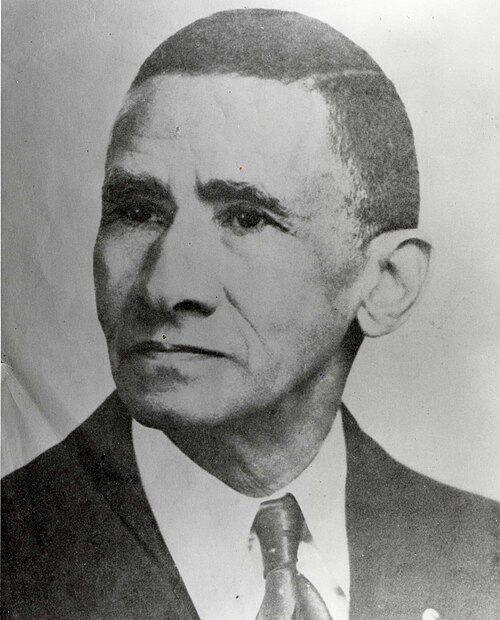
Once upon a time in Black Entrepreneur History lived a Black American man named Isaac Scott Hathaway who became the founder of that Hathaway Art Company, a master ceramicist and inventor, professor and the designer of the first Black American coin which featured Booker T. Washington.
Isaac Hathaway was born in 1872 in Lexington, Kentucky where he grew up with his siblings under the rearing of only is father as his mother passed away when he was only two years of age. His father was formerly an enslaved, in bondage under U.S. Senator Garret Davis of Bourbon County, Kentucky.
Isaac Hathaway’s father educated him on the arts, taking him to a museum to view several sculptures of American figures, and when Isaac didn’t see any of the busts that mirrored his image as a Black American, he wondered why? His father told him that there were no busts of people like them because there wasn’t a sculptor to do it, and that’s when little Isaac set in his mind that he would be the one to design busts of his own Negro heroes so that his people and others could admire the people that he looked up to. Not only did he accomplish this goal, but he even went beyond.1

Isaac Hathaway’s Education and Career
When he finally enrolled in college, he went learn the art of ceramics at Chandler College in the state of Kentucky and Pittsburgh Normal College in Kansas, following up his love for ceramics and art at the New England Conservatory of Music, State University of Kansas, Cincinnati Art Academy (Ohio), and the State University of NY. With all of this education and ability, he became a master of the ceramic arts and sculpting, always remaining updated on the latest techniques in his field as he began is career as a teacher of primary school and later a professor at the prestigious Black American founded Tuskegee Institute in Alabama.
When Dr. Isaac Hathaway became a professor of arts and ceramics at Tuskegee Institute, he was one of the most famous as there were many well esteemed Black American educators at the prestigious school. He created his art inside a workshop that was a large one story, brick building in a huge room, and he would create from morning to night. His focus on his work was exceptional, and whenever he wasn’t in his workshop, he was out gathering clay on Tuskegee campus, leaving a note letting everyone know that he was out gathering clay and he would be back at 1 o’clock.
The reason Hathaway had to use the clay pits at Tuskegee was because the institute didn’t have enough money to supply him with the actual ceramic clays, so Hathaway had to make due with what he had available on the land, so this led him to also developing the art of using local clays (Alabama kaolin clay) to make fine pottery which was a breakthrough in ceramics. Professor Hathaway experimented with the local clay – mixing, treating and firing – all by himself and with his own hands – no special modern equipment nor any help from others. Even the oven he used for the clay was partially homemade.
While there, he invented a new art of clay cooking utensils. According to the Alabama Journal, “One of these clay cooking utensils was the exact outline inside of a half spring chicken lying on a dining table platter. The purpose was to back boneless, molded chicken. The chicken was stripped from the bones and would be laid in the clay mold, pressed into place with dressing and closed in by the other half of the of clay utensil to back the chicken in the form of a fowl, which was all meat and dressing.“2
Isaac Hathaway created this new art of clay cooking because he thought it made dining attractive. With Hathaway, he wasn’t only making a clay dish to cook food, but he was creating the food, meat in his case, in the form of an animal, and the final result of cooking it in the clay utensil was edible.
Hathaway’s line of clay utensils varieties were created to cook food sculptures, and of course, the clay utensils he created could be reused to create the same shape of food each time. His clay utensils were so popular that when he gave his clay pan to a chef for a trial run, the chef was so impressed with the pan’s heat holding qualities that woman chef kept it for good.
The Isaac Hathaway Art Company, previously known as Afro Art Company, which he founded around 1907, sold many utensils, pottery busts and more for several institutions, and had many locations around the USA as it moved with him, from Washington D.C. to Tuskegee.
Isaac Hathaway’s Plaster Busts and Masks
Hathaway was also known for his skill in creating plaster busts and masks. One such time, there was a death in 1904 of a man named Wayne who died bound to a wire fence with a gun on his side. Apparently the gun had gone off accidently as Wayne was trying to cross the fence. At this time, the attorney for the deceased Wayne was in court trying to win the insurance claim for the man which refused pay out for suicide, so it was the attorney’s responsibility to prove that it wasn’t a suicide but accidental.
The attorney, William Marshall Bullitt, called on someone skilled to create a plaster of the crime scene to show the crime scene to the court that it bore tracks of cow’s hoofs and other markings and that the ground was bare gravel. Every single White American expert said that the plaster could not be done, but when Hathaway heard about it, he accepted the challenge. He successfully produced the cast that was 15 feet by 7.5 feet to the court, according to the Alabama Journal of 1943.
The cast was even painted in the colors needed along with the added gravel and dirt surface. When the defense saw it, they were outraged and objected, saying that the ground was undercut and brought into the courthouse, but that was a lie. Hathaway then proved the defense wrong by sticking a knife into the cast to show that it was all plaster, no real ground. Then he explained how he “shellacked the ground” so that no pebble stuck to the plaster. Successfully, the cast of the scene was admitted into evidence for the courts, and the case ended up being settled.
After this, it was stated that Hathaway’s ambition is to lead to many more jobs for Black Southerners as experts in ceramics as they are emotional enough to place “expression into clay.”
Other amazing plasters and busts Isaac Hathaway created were:
- Booker T Washington
- WEB DuBois
- Frederick Douglass, known to be his favorite hero
- John E. Bush -Mosaic Templars of America cofounder
- Floyd Brown – Fargo Agricultural School founder
- Scipio A. Jones – Civil Rights Attorney
- John Brown Watson – Arkansas AM&N president
- Paul Laurence Dunbar
- Richard Allen
One of his most famous pieces was when he was commissioned by the president Harry S. Truman to commemorate Booker T. Washington, founder of Tuskegee University, with a 50 cent piece by the US Mint, and this made him the first Black American to ever design a United States coin. This took place in 1946 and only five years later, he designed another 50 cent piece for George Washington Carver, the Black American agriculturalist and professor at Tuskegee known today for saving the agricultural landscape of the USA amongst other inventions.
Isaac Hathaway’s Death & Legacy
Isaac Hathaway passed away on March 12, 1967 after a life of providing Black American art to his people and to the world being the man who introduced ceramics to college education in the USA, while founding the first ceramics department ever in the USA (1937) at Tuskegee while being the first Black professor of the course both at Tuskegee Institute and at Alabama Polytechnic Institute, an all white school, in 1947 which is now Auburn University. He was the first black professor to teach anything at Alabama Polytechnic Institute. He died in Tuskegee, Alabama.
Sources:
- African American Registry, https://aaregistry.org/story/isaac-hathaway-a-pioneer-in-sculptor
- Alabama Journal;, Cooking Utensils Made From Tuskegee Clay”, Montgomery, Alabama, April 9, 1943, Page 14
- Credit Photo of Isaac Hathaway, https://commons.wikimedia.org/wiki/File:Portrait_of_Isaac_Hathaway.jpg, no changes made


More Related Stories
James Wormley – Founder of the Most Expensive Hotel in Washington D.C. in 1800s – the Wormley Hotel
William E. Matthews – Wealthy Financial Broker & Civil Rights Leader of 1800s
Charles Porter Grove – Owner of Montana and Illinois Gold Mining Company & Leader of the “Dreamed” Grove City, Montana